Intelligent Operations & Orchestration4 min read
The traditional digital services model is obsolete.

Vijay Ijju05 Nov 2025

The future of AI begins with people.
Culture, People & Leadership
The future of AI begins with people.

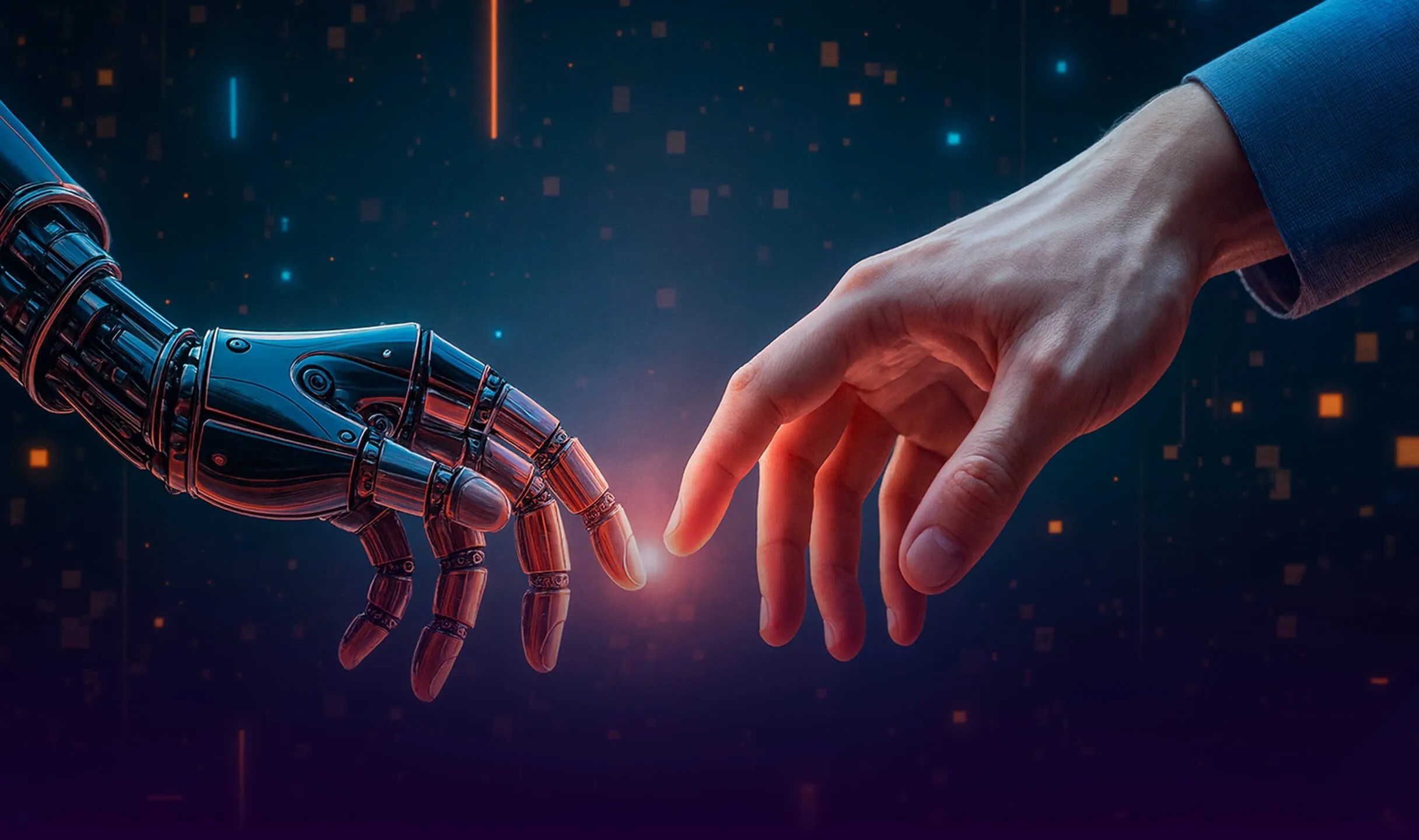
The conversation about AI in the enterprise often begins with tools, models, and data. But in reality, it begins with alignment. Before an organization can move toward a new way of working—where humans, digital workers, and systems learn together—it must adopt the mindset that makes orchestration possible. That shift doesn’t start in a data lab. It starts with culture—the operating system for intelligence.
AI doesn’t begin with algorithms; it begins with orchestration. Before intelligence can scale across an enterprise, the behaviors that enable coordinated, governed, human-in-the-loop systems must take root.
This cultural operating system is what allows orchestration at scale to function—because adaptive, intelligent systems require not just smarter models, but smarter behaviors.
Too often, organizations rush into AI by building proofs of concept or automating isolated tasks, only to discover later that the real barriers were behavioral, not technical. Teams weren’t aligned. There was no shared language for risk. Governance was an afterthought instead of an anchor. Without a cultural operating system, even the strongest AI tools struggle to take root.
Culture isn’t the soft side of transformation; it’s the structural backbone that determines whether intelligence can scale. It becomes the governance layer that guides how humans, digital workers, and systems learn together responsibly.
At Gradera, we call this model Software-Orchestrated Services™ (SoS™)—an operating system where culture, governance, and orchestration converge to make AI sustainable, safe, and scalable. The foundation of an AI-First Enterprise isn’t technology; it’s trust—the substrate that allows systems to evolve responsibly. Because when curiosity and governance coexist, intelligence doesn’t just automate work; it amplifies it.
Most transformation programs begin by asking, “What should we automate?” The better question is, “Why should we automate?”
“AI doesn’t fail because the models are weak — it fails because the behaviors around them never change.”
The AI-First journey begins with people, not platforms. Culture is the first layer of orchestration, the mindset that shapes how teams adapt, make decisions, and measure impact.
Technology can learn, but it learns what we teach it. If curiosity, accountability, and shared ownership aren’t embedded in how a company operates, no algorithm can fix that. The future-ready enterprise isn’t the one that adopts the most AI; it’s the one that cultivates a culture capable of learning alongside it.
Many enterprises start with automation or heavy tooling, only to realize later that the behaviors surrounding those tools remain unchanged. Silos persist. Decisions stay opaque. Knowledge continues to live in individual heads rather than shared systems. In these cases, AI doesn’t accelerate progress; it accelerates the existing dysfunction. But when culture is the foundation, AI becomes an amplifier of good habits.
At Gradera, we refer to this harmony as part of Adaptive Intelligence — the system that learns and evolves through both human and digital inputs inside a governed enterprise context.
Tina Ward, our People Operations leader, often says that trust is the most powerful dataset an enterprise can generate. It allows for experimentation without fear, transparency without risk, and learning without hesitation.
“Trust is the most powerful dataset an enterprise can generate.”
Curiosity and trust are the raw materials of organizational learning. When teams feel safe to ask why, challenge assumptions, and share what doesn’t work, the enterprise begins to behave like a learning organism. That’s when intelligence becomes sustainable.
In an AI-First culture, curiosity isn’t chaos; it’s a structured rhythm. Teams are encouraged to test ideas in micro-environments, reflect on outcomes, and integrate those learnings across the organization. Responsible AI begins here, not as a compliance checklist, but as a cultural reflex.
Trust also reinforces transparency. When people believe the system is learning with them rather than judging them, they are more willing to contribute insights, data, and improvements.
In an AI-First enterprise, every contribution, whether a correction, clarification, or question, becomes part of the organization’s evolving intelligence.
“Curiosity isn’t chaos — it’s the rhythm of a learning enterprise.”
An AI-First culture isn’t just expressed through behaviors — it’s reinforced through clarity. That’s why Gradera established an AI-First Use Policy early: to guide how teams experiment, what data can be used, and how human judgment stays at the center of every AI interaction. A policy doesn’t constrain innovation; it protects it. It gives people the confidence to explore responsibly, knowing the boundaries are clear and the guardrails are intentional.
“A policy doesn’t constrain innovation; it protects it.”
Most enterprises don’t struggle with AI because of tooling gaps—they struggle because adoption isn’t managed as an organizational capability. Culture gives teams the mindset to learn. Policy provides the boundaries to explore responsibly. But sustained adoption requires something more: a structured way to prepare people, evolve roles, communicate purpose, and build trust as intelligent systems scale.
This is why Gradera created Organizational AI Adoption Management—a discipline focused on aligning people, processes, and culture so AI becomes a natural extension of how teams work, not a disruption to it. It integrates readiness planning, communication frameworks, role evolution, and capability building into one governed approach.
In practice, it ensures that every AI deployment is not only introduced well — but internalized well.
Culture by itself can inspire change. But when culture aligns with the principles behind Software-Orchestrated Services™ (SoS™), that change becomes sustainable and scalable.
Through the SoS™ model, Gradera unites advisory, platforms, and solution suites into a governed system where software orchestrates, humans decide, and digital workers execute. Human + Digital Harmony isn’t an ideal; it’s an operating state.
Here’s how orchestration works in practice:
- Feedback becomes a system, not a survey. Data from people, processes, and platforms is orchestrated through Neural IQ™, enabling insight to circulate across the enterprise at the right moment, in the right context.
- Governance becomes embedded. Explainability, auditability, and policy alignment are integrated into workflows rather than enforced manually.
- Learning becomes continuous. Value360™ quantifies readiness, efficiency, and growth, allowing teams to evolve with software and not behind it.
- Execution becomes coordinated. NexusFlow™ ensures that digital workers and human teams operate with shared context, governed transitions, and measurable outcomes.
This orchestration turns culture into capability. Daily standups evolve into signal reviews. Success metrics shift from activity to outcomes. Handoffs become orchestrated transitions instead of manual coordination. And because context travels with the work, teams don’t spend time rediscovering what the organization already knows, they build on it.
The result isn’t automation for its own sake. It’s a living system that evolves through human judgment and software discipline.
One of the most misunderstood aspects of transformation is governance. Many treat it as a brake on innovation, when in reality, it is the steering wheel.
The more complex the system, the greater the need for transparency. Responsible AI is not about restricting possibility; it’s about creating confidence. When teams understand how a decision was made and why it was approved, adoption accelerates naturally.
At Gradera, we design governance into orchestration. Explainability is built into Neural IQ™, allowing leaders to see not just what the system did, but how it learned. These guardrails turn accountability into a feature, not a burden.
Governance also creates psychological safety. When people know the boundaries — ethical, procedural, and operational — they’re more willing to innovate. Guardrails protect creativity. They ensure that experimentation happens with integrity, and that every insight strengthens the enterprise rather than exposing it to unnecessary risk.
Trust isn’t declared in policy. It’s demonstrated in practice.
While AI-First culture shapes how every team at Gradera learns and operates, our Product Engineering organization is where these principles turn into practice. This is the proving ground for Software-Orchestrated Services™—the place where curiosity, governance, and intelligent tooling converge to shape the systems we will ultimately deliver to customers.
Our engineering teams begin every major capability the same way our customers will: with Value360™. We apply the framework internally to map workflows, identify where digital workers and human-in-the-loop interactions belong, surface enterprise knowledge dependencies, establish governance requirements, and define the quality rubrics that our system must uphold. The same blueprinting discipline we use with clients guides how we design NeuralIQ™, NexusFlow™, and ProductPhi.
From there, ProductPhi becomes the engine of execution—a structured way of turning discovery into functional and non-functional backlogs. It gives our teams a shared language for intent, user journeys, orchestration patterns, and the intelligence behaviors we expect the system to learn over time. ProductPhi isn’t just a framework for customers; it’s the core of how we build our own product.
Across the stack, our engineers work with an AI-First toolchain that reflects the future we’re designing: React and Next.js for experience layers, .NET and TypeScript for high-performance services, Kubernetes and Terraform for infrastructure, AMQP-based messaging for event-driven patterns, and a modern testing ecosystem spanning Vitest, Playwright, xUnit, and Testcontainers. Each component is selected not just for capability, but for how well it supports intelligent orchestration, observability, and iterative learning.
Quality and governance are not afterthoughts—they are engineered into the process. Tools like SonarQube, OpenTelemetry, ELK, Storybook, and automated test pipelines ensure that feedback flows continuously through the system. Every commit, build, and test run becomes a signal that contributes to how our platform evolves. It’s engineering as a learning loop, not a linear cycle.
What emerges is not just software, but an operating rhythm:
teams and systems learning together, guided by governance, accelerated by AI, and orchestrated through evolving intelligence patterns. This is where the SoS™ model comes alive—long before it reaches a customer environment.
Gradera’s Product Engineering team is building the future of enterprise work by living it.
Building an AI-First culture isn’t about preparing for technology. It’s about preparing for change. It’s about designing an organization that learns faster than the world around it.
An AI-First enterprise isn’t defined by how much AI it uses, but by how responsibly it learns. When curiosity, trust, and governance become orchestrated habits, intelligence ceases to be a department. It becomes the way the enterprise operates.
And as operators, our responsibility isn’t just to deliver outcomes. It’s to build systems where people and software learn together, improve together, and evolve together.
That’s the true mark of an AI-First enterprise: not intelligent tools, but intelligent behavior.
“The true mark of an AI-First enterprise isn’t intelligent tools — it’s intelligent behavior.”
The traditional digital services model is obsolete.

Enterprises today are not struggling with AI ambition — they’re struggling with AI outcomes.