Culture People & Leadership9 min read
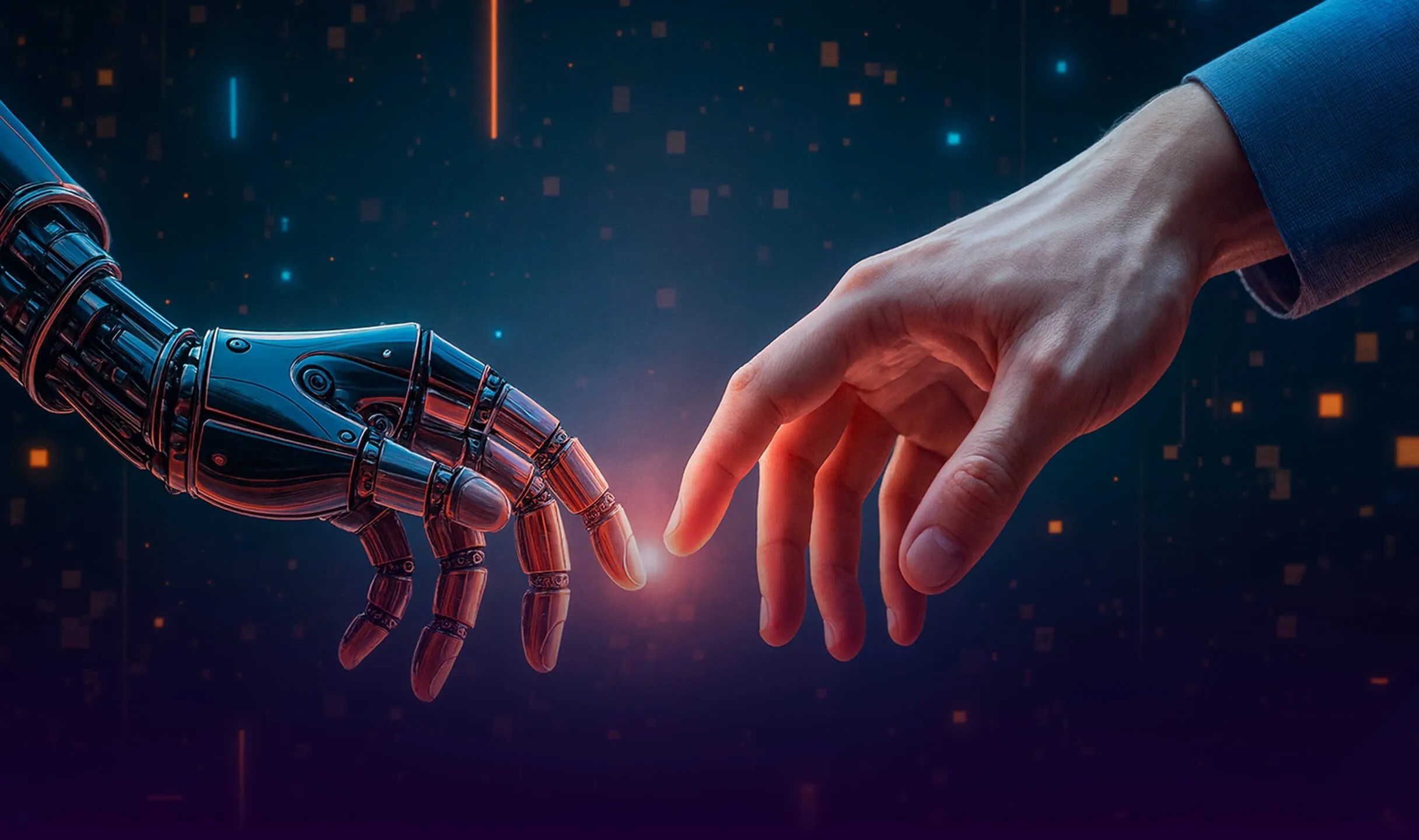
The future of AI begins with people.

Stuart Price12 Nov 2025

The traditional digital services model is obsolete.

Intelligent Operations & Orchestration
The traditional digital services model is obsolete.

Built on armies of consultants, static roadmaps, and long transformation timelines, it was designed for a different era—one where scale meant headcount, outcomes were measured in invoices, and AI was still theoretical.
Today, enterprises don’t need more bodies. They need to see efficiencies in the way outcomes are delivered. They need the ability to orchestrate work across humans, intelligent digital workers, enterprise platforms, and external ecosystems with governance, precision, reliability, and adaptability.
Software-Orchestrated ServicesTM represents this shift—a category-defining leap from labor-led delivery models to a programmable, real-time execution fabric that blends human expertise with intelligent systems. In this new paradigm, the orchestration fabric becomes the core. It decides who (or what) should act, adapts to changing context, enforces governance, and continuously learns from outcomes. This is not outsourcing. This is not automation. This is the architecture of transformation itself—built for agility, driven by intelligence, and measured by outcomes.
We’ve lived it.
We built a successful global digital transformation services firm, PK Global — scaling it from a bootstrap operation in 2004 into a 6,000-person company that delivered complex solutions to Fortune 500 clients. We've guided large-scale transformations in telecom, healthcare, transportation, financial services, insurance, retail, and more.
We’ve seen firsthand the limitations of labor-heavy delivery models:
- High cost of talent and overhead
- Long lead times for execution
- Fragmented ownership of outcomes
- Static workflows and siloed tools
- Talent turnover affecting delivery consistency
The traditional model works—until it doesn't. It simply can't keep pace with how fast enterprises need to move, adapt, and deliver results today.
This is exactly why we started Gradera—to launch a new era of digital transformation services.
Software-Orchestrated Services are not just about automation or AI—they’re about architecting and deploying a platform that can intelligently coordinate how work gets done efficiently. It’s a system that blends the scale of software with the nuance of human expertise—without the handoffs, bottlenecks, and variability that plague traditional models.
The core of this model is the Orchestration System of Intelligence. This system enables real-time, governed, and adaptive collaboration between human experts, digital workers, enterprise tools, and external ecosystems.
At Gradera, we’ve architected this system of intelligence across four interlocking layers:

NeuralIQ is the system of intelligence core. It manages the orchestration between the different layers. Each component of this core has a specific responsibility: knowledge, memory, orchestration, model routing, data management, evaluation, asset repository, access to enterprise ecosystem tools, and observability. The glue that makes these components work together is NexusFlow TM, the core plumbing that ensures signals flow through this system, between digital workers and humans, most efficiently.
Think of NeuralIQ as a cognitive nervous system that:
- Orchestrates execution across your enterprise stack
- Applies memory, feedback, and policy to every interaction
- Adapts to real-time signals and balances automation with human oversight
- Embeds governance, explainability, observability, and trust by design
It’s not just workflow—it’s real-time intelligence orchestration.

Every enterprise has its own language, structure, and DNA. PhiSphere captures that. It translates internal data, tools, roles, and priorities into actionable intelligence that powers the orchestration layer. This is where we capture repeatable archetypes specific to a domain within the enterprise – Product, Marketing, Operations, Sales - as well as reimagining processes within a particular industry vertical – such as revenue cycle management in Healthcare or claims adjudication for insurance firms.
PhiSpehere suite :
- Delivers domain-specific, context-aware digital workers
- Empowers digital workers to speak the language of the enterprise
- Provides transparency and visibility across orchestration flows
- Enables humans to stay in control of evolving systems
With PhiSphere, orchestration becomes personalized and precise.
Transformation without metrics is just guesswork. Value360 brings strategic clarity and continuous evaluation to the orchestration fabric. This is our advisory service that :
- Maps current enterprise value chains and tasks
- Classifies which tasks are best suited for human, Digi Worker, or hybrid execution
- Forecasts ROI and prioritizes transformation zones
- Provides executive-level visibility into AI-driven outcomes
It ensures every orchestration decision is backed by business value and operational insight.
Enterprises can’t afford another wave of expensive, static transformation initiatives. AI is real—but it's fragmented, hard to govern, and often disconnected from value. Most solutions stop at the proof-of-concept stage because the missing piece is orchestration.
We’ve spent years building services. We know what works—and what breaks.
This time, we’re building something different: a system that can learn, adapt, execute, govern, and scale. A system that brings the best of human expertise and digital execution into a single, intelligent rhythm.
If your enterprise is navigating fragmented platforms, AI pilots with no ROI, or delivery models that don’t scale—you’re not alone. The industry is at an inflection point.
The answer isn’t more services.
It’s a better system.
Software-Orchestrated ServicesTM represents that system of intelligence —where transformation is ongoing, intelligent, and measurable from day one. It’s a model built not just to deliver outcomes, but to continuously improve them.
And it’s here at Gradera.
The future of AI begins with people.

Enterprises today are not struggling with AI ambition — they’re struggling with AI outcomes.